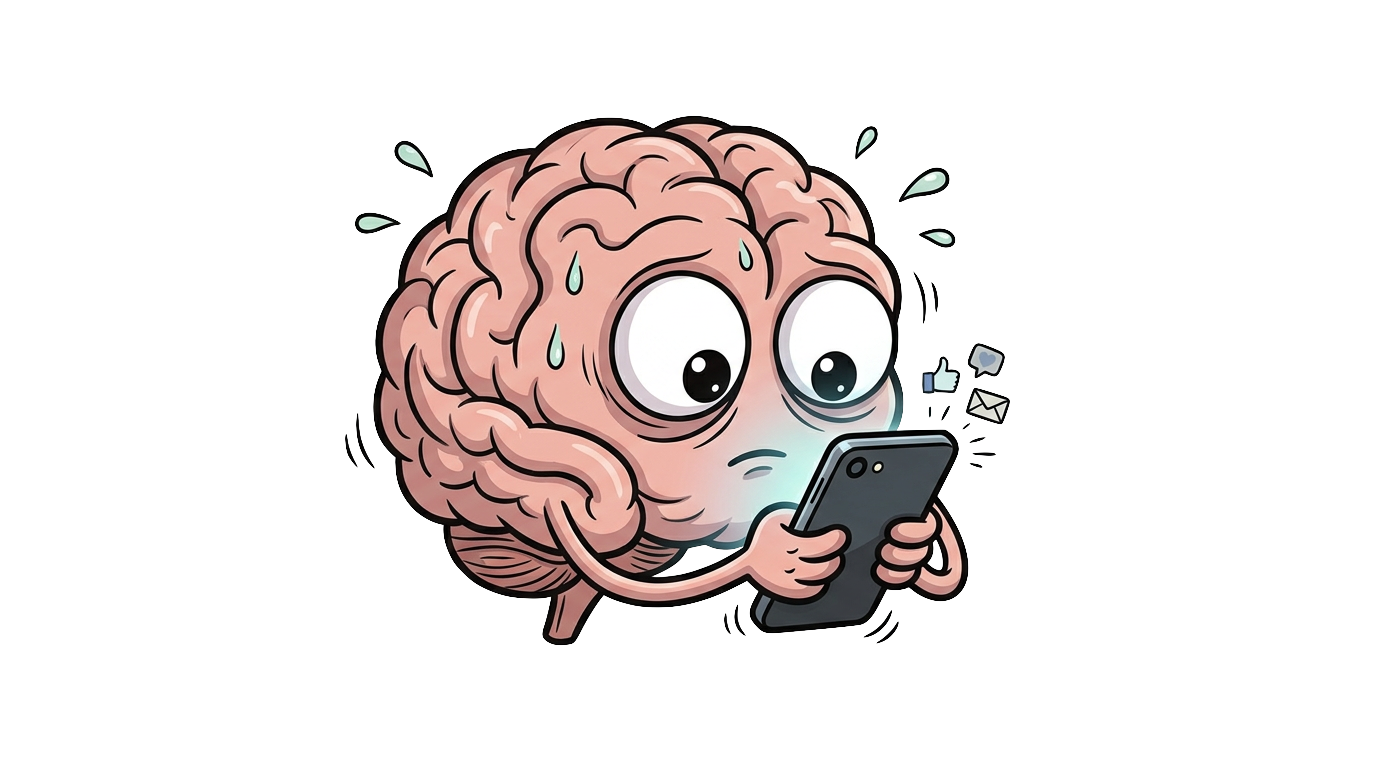
Here is something that might sound familiar. You pick up your phone, open social media, scroll for fifteen minutes, put it down, and realize you didn’t enjoy a single second of it. You weren’t looking for anything specific. You weren’t entertained. You just did it, the way your hand reaches for a light switch in a dark room.
Most coverage of this phenomenon lands on a simple explanation: the social media dopamine loop. You scroll, you get a dopamine hit, you keep scrolling. The reality is stranger and, honestly, more unsettling than that framing suggests. The neuroscience points to a specific dissociation in the brain’s reward system that the platforms have learned to exploit, whether or not their designers fully understood the mechanism.
The short version: dopamine doesn’t make you feel good. It makes you want.
Wanting vs liking: how dopamine actually works
Kent Berridge, a neuroscientist at the University of Michigan, has spent decades studying the difference between two components of reward that most people assume are the same thing. “Wanting” is the motivational pull toward something, the urge, the craving, the impulse to check. “Liking” is the actual hedonic pleasure you get when you arrive. These are mediated by different neurotransmitter systems. Wanting runs on dopamine. Liking runs primarily on opioid and endocannabinoid circuits. They often fire together, but they don’t have to.
This distinction matters enormously for understanding social media use. A 2021 study by Ihssen and Wadsley, published in Addictive Behaviors with 358 participants, measured both wanting (urges to check social media) and liking (actual enjoyment of using it) separately. Wanting predicted how often people checked their phones and how problematic their use became. Liking did not. People who reported the strongest urges to check weren’t the ones who enjoyed it most. They were just the ones whose wanting system had been tuned up while their liking stayed flat or even declined.
This is the specific phenomenology that almost every smartphone user recognizes: the pull is strong, but the payoff is hollow. You aren’t scrolling because it feels good. You’re scrolling because your brain has learned to want it, which is a different thing entirely.
How platforms train the wanting system
Dopamine neurons don’t fire when you receive a reward. They fire on what neuroscientist Wolfram Schultz calls “reward prediction errors,” the gap between what you expected and what you got. A notification that might contain exciting news, or might contain nothing, generates more dopamine activity than a guaranteed reward of known value. Unpredictability is the key input.
Social media platforms are, structurally, machines for generating prediction errors at scale. Every pull-to-refresh is a spin of a variable-ratio reinforcement schedule: sometimes you get a flood of likes, sometimes a funny video, sometimes nothing. Tristan Harris, a former Google design ethicist, made the slot machine comparison famous, and it holds up under scrutiny. A 2025 review by Wang and Wang in Behavioral Sciences confirmed that social media delivers variable-ratio reinforcement in the same pattern that behavioral psychology has known since B.F. Skinner’s pigeons: unpredictable rewards on a variable schedule produce the most persistent, compulsive behavior.
What’s different about social media, compared to a slot machine or even a bag of chips, is the sheer density of reward events. Clark and Zack, writing in Addictive Behaviors in 2023, introduced the concept of “temporal compression”: social media delivers hundreds of variable-reward events per session, at a pace that would be physically impossible in the offline world. Your brain is processing prediction errors at a rate it never evolved to handle.
The platforms have fine-tuned this through specific design choices. Infinite scroll, invented by Aza Raskin (who publicly expressed regret about it as early as 2018), removes natural stopping cues that pagination once provided. Snapchat’s streak mechanics exploit loss aversion by threatening to break a streak if you don’t send a snap within 24 hours, complete with an hourglass emoji to create urgency. TikTok’s recommendation algorithm monitors not just your likes and follows but passive behaviors: how long you watch, whether you replay, where you pause. The average TikTok user opened the app 17 times per day as of early 2022, spending an average of 1 hour and 25 minutes daily.
None of this is accidental. Sean Parker, Facebook’s first president, said it plainly in a 2017 interview with Axios: “How do we consume as much of your time and conscious attention as possible? We give you a dopamine hit, exploiting a vulnerability in human psychology.” He described the design process as deliberately creating “a social-validation feedback loop,” essentially a dopamine loop by design. Parker isn’t a disgruntled outsider. He was there when these systems were built.
The Stanford connection and the anger multiplier
The intellectual lineage is traceable. B.J. Fogg ran the Persuasive Technology Lab at Stanford, where he trained students in the principles of behavior design. Among his students: Mike Krieger, who went on to co-found Instagram with Kevin Systrom, and Tristan Harris, who later became Silicon Valley’s most prominent critic of the attention economy. In a 2007 Stanford course, Fogg’s students used persuasive design techniques to create Facebook applications that reached millions of users within ten weeks.
These design principles evolved over time. Internal documents leaked in 2021 revealed that Facebook had weighted emoji reactions five times more heavily than a standard like in its engagement-ranking algorithm, and kept this weighting in place for three years. Because content provoking anger tends to generate more emoji reactions, angry content spread disproportionately further. According to reporting on the leaks, Mark Zuckerberg resisted changes because they might reduce engagement metrics. This isn’t a neutral platform passively hosting content. It’s a system that learned anger is engaging and quietly amplified it.
What the brain scans show
A three-year longitudinal fMRI study by Maza and colleagues, published in JAMA Pediatrics in 2023, tracked 169 adolescents and found something that should concern anyone paying attention. Teens who checked social media more than 15 times per day showed progressively increasing neural sensitivity to social anticipation in the amygdala, anterior insula, ventral striatum, and dorsolateral prefrontal cortex over the study period. Teens who checked less frequently showed the opposite pattern: decreasing sensitivity over time.
This means habitual checking doesn’t just reflect existing brain differences. It appears to physically change how the adolescent brain develops its sensitivity to social cues. The brains of heavy checkers were becoming more reactive to the anticipation of social rewards, which means the wanting system was being progressively sensitized.
A systematic review by Wadsley and Ihssen in Brain Sciences (2023), covering 28 MRI studies, found a pattern: problematic social media use was associated with reduced volume in the ventral striatum, amygdala, and prefrontal regions, but increased striatal activity in response to social media cues. Structurally smaller reward regions, but functionally more reactive to the specific triggers platforms provide. The architecture of the wanting system appears to be reshaped by use.
The uncomfortable middle ground
Before this reads as a straightforward horror story, some necessary complications.
Neither the DSM-5 nor the ICD-11 recognizes “social media addiction” as a diagnostic category. Panova and Carbonell argued in 2018 that excessive use doesn’t equal addiction, and they have a point. The word “addiction” carries clinical weight that the evidence may not fully support for most users.
The effect sizes in population-level studies are often small. Orben and Przybylski, in a widely discussed 2019 paper in Nature Human Behaviour, used specification curve analysis to show that social media’s association with reduced wellbeing was comparable in magnitude to eating potatoes daily or wearing glasses. Christopher Ferguson’s meta-analyses have found no significant correlation between social media use and mental health outcomes. Candice Odgers, writing in Nature in 2024, called Jonathan Haidt’s claims about social media and teen mental health “not supported by science” and warned that the panic “might distract us from effectively responding to the real causes.”
This criticism has merit. There is a long history of moral panics about new media, from novels to radio to television to video games, and the pattern of adults blaming youth problems on the latest technology is genuinely old. Analyses of CDC Youth Risk Behavior Survey data have found that for certain vulnerable groups, including LGBQ teens, online social connectivity appears protective rather than harmful. For isolated and vulnerable young people, social connection can be a lifeline.
So is the concern overblown? I don’t think so, but the framing matters. The population-level correlation between “time on social media” and “poor mental health” may be small and noisy. But that’s partly because “time on social media” is a crude measure that lumps together video calls with grandparents, craft tutorials, doomscrolling political outrage, and passive comparison of curated highlight reels. The mechanism that Berridge’s wanting/liking framework identifies, where design patterns sensitize the wanting system independently of enjoyment, is a more specific and more testable claim than “social media is bad.”
Wang and Wang’s 2025 review describes a dual-pathway model that maps onto this distinction. Early problematic use is driven by positive reinforcement (seeking the dopamine-mediated anticipation of social rewards). Later stages shift to negative reinforcement (using social media to avoid withdrawal symptoms, boredom, or negative emotions). This mirrors the three-stage addiction model proposed by Koob and Volkow for substance use. Whether or not “addiction” is the right clinical label, the progression from seeking pleasure to avoiding discomfort is real and recognizable.
The numbers behind the design
The business incentives here are not subtle. Meta’s revenue hit $200.97 billion in 2025, up 22.2% year-over-year. TikTok generated $23 billion in 2024, up 42.8%. These companies are paid by advertisers for your attention, measured in time spent and engagement. Every design decision that increases time-on-platform increases revenue. The billions of people using social media globally spend an average of over two hours per day on these platforms.
Americans check their phones 186 times per day, according to Reviews.org data from late 2025. That’s roughly once every five waking minutes. This is not the behavior profile of someone settling in for an enjoyable experience. It’s the profile of a wanting system being triggered, briefly satisfied by a check, and triggered again minutes later.
Among teens, 46% say they’re online “almost constantly” according to Pew Research Center’s December 2024 data, and 48% of teens now say social media has a mostly negative effect on people their age (up from 32% in 2022, per Pew’s April 2025 survey). Nearly half of teens themselves recognize the problem, even as they continue using. That gap between recognition and behavior is, again, the wanting/liking dissociation at work.
Breaking the social media dopamine loop
The standard advice for reducing screen time, set app timers, use grayscale, put your phone in another room, targets the friction around accessing the phone. That’s useful but limited because it doesn’t address the sensitized wanting system underneath. You can put your phone in a drawer and still feel the pull every few minutes, because the wanting doesn’t go away just because the phone is further away. As anyone who has tried a digital detox knows, the urge often intensifies before it fades.
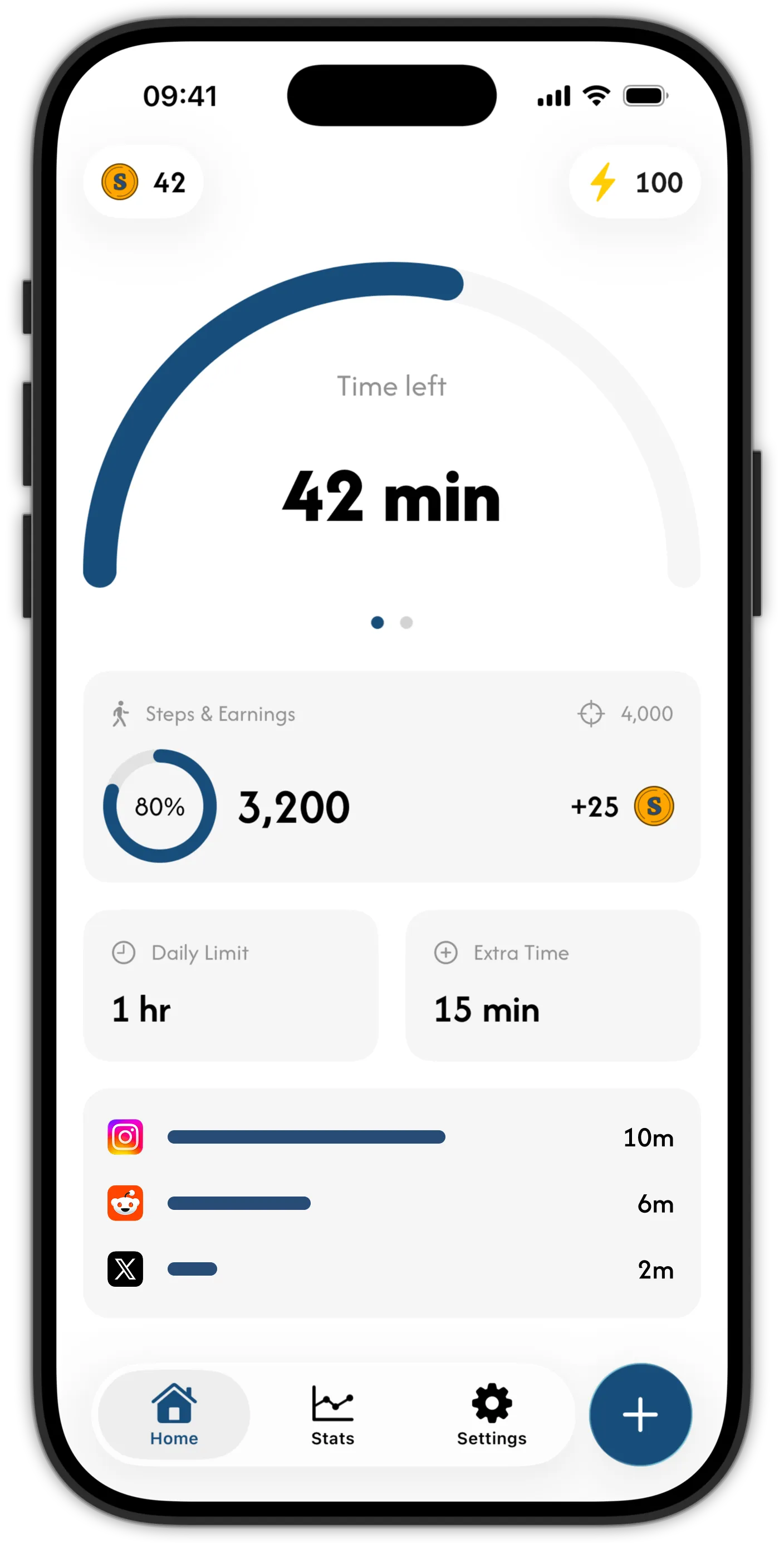
This is one of the reasons we built Skrid around earning screen time through walking. Pure restriction fights the wanting system head-on, which is exhausting and tends to fail once willpower depletes (emerging evidence from screen time reduction studies shows rapid rebound once restrictions are lifted). Replacing the loop with a different one, where physical movement becomes the thing that earns access, changes the cost structure rather than just adding friction.
Walking itself has independent effects on the dopamine system. Exercise increases dopamine receptor availability and promotes neuroplasticity in prefrontal regions involved in impulse control. There’s a reason a walk often reduces the urge to check your phone: it provides genuine reward (the liking side) in a way that scrolling increasingly doesn’t. The research on how many daily steps actually matter for health suggests the bar is lower than most people think.
If you’re curious about the broader cognitive effects of heavy phone use, the research on how smartphones affect memory formation adds another dimension. The wanting system doesn’t just drive you to check your phone compulsively. When you do check, the constant context-switching appears to interfere with how memories consolidate.
The real question
The neuroscience of the social media dopamine loop is often presented as a simple story: platforms give you dopamine, dopamine feels good, you get hooked. The actual story is that platforms train your brain to want something that doesn’t reliably deliver pleasure, and the gap between wanting and liking widens with use. You don’t scroll because you enjoy it. You scroll because the wanting system, shaped by thousands of variable-reward events, generates an urge that the liking system can’t match.
Understanding this won’t make the urge disappear. But recognizing that the pull you feel isn’t desire for something good, it’s a prediction error signal tuned by design, makes it slightly easier to pause before the next pickup. The phone isn’t offering you something you want. It’s exploiting a system that doesn’t know the difference.