In 2011, psychologist Betsy Sparrow at Columbia University ran an experiment that would later be called the “Google Effect” study. Participants were given trivia facts to remember. Some were told the information would be saved on a computer. Others were told it would be erased.
The result, published in Science: people who expected the information to be available later were significantly worse at remembering it. But they were better at remembering where to find it.
“The Internet has become a primary form of external or transactive memory,” Sparrow wrote, “where people know not the information but where the information can be found.”
This finding has been replicated and extended over the past fifteen years. The pattern holds for photos, GPS navigation, and basic facts we assume Google will always have. We aren’t just using our devices for convenience. We’re actively shifting how our memory systems operate, treating phones as external storage rather than building internal knowledge.
The interesting question isn’t whether this is happening. The research is clear that it is. The question is whether this trade is one we’re making consciously, and whether the costs are showing up in places we haven’t noticed yet.
The transactive memory bargain
The concept Sparrow built on, transactive memory, comes from earlier research by Daniel Wegner in 1985. The original insight was about couples and teams: people in close relationships share cognitive labor. One partner remembers birthdays, another handles travel logistics. Neither needs to remember everything because they know who to ask.
What’s new is that our devices have become our primary transactive memory partners. We outsource phone numbers, addresses, appointments, directions, and most factual knowledge to something we carry in our pockets. This is wildly efficient in some ways. It frees mental resources. It lets us access vastly more information than any human could store internally.
But the tradeoffs are real.
A 2014 study by Linda Henkel at Fairfield University, published in Psychological Science, found that photographing objects in a museum led to worse memory of those objects compared to simply looking at them. People remembered fewer objects, fewer details, and even where objects were located less accurately. The act of taking the photo seemed to signal that memory wasn’t required.
There was an interesting exception. When participants zoomed in on specific features while photographing, their memory wasn’t impaired. Selective attention counteracted the offloading effect. The camera didn’t automatically weaken memory; the assumption that the camera would handle remembering did.
GPS and your hippocampus
The navigation case is especially striking because we can see what happens in the brain.
A 2020 study in Scientific Reports by Dahmani and Bohbot found that greater lifetime GPS experience correlated with worse spatial performance and spatial memory. Neuroimaging work at UCLA and elsewhere shows that people using GPS directions have measurably less hippocampal activity than self-navigators.
The hippocampus is where spatial maps are built. It’s also central to converting short-term memories into lasting ones. When you follow turn-by-turn directions, you’re mostly relying on egocentric navigation (turn left here, turn right there), which activates different brain regions. The hippocampus stays relatively quiet. Over time, the concern is that reduced use leads to reduced capacity.
This doesn’t mean GPS is bad. It means there’s a cost to always using it, one that’s invisible until you try to find your way without it.
The brain drain effect
Even when we successfully resist checking our phones, their presence still seems to matter.
A 2017 study by Ward and colleagues in the Journal of the Association for Consumer Research found that the mere presence of a smartphone reduced available cognitive capacity. Working memory and fluid intelligence were measurably affected. Critically, this happened without interrupting sustained attention and without participants thinking about their phones more than those who’d left them in another room.
The phone on the desk wasn’t a distraction in the usual sense. It was a drain. Some part of cognitive resources went toward not checking it, leaving less available for the task at hand.
This maps onto the attention research more broadly. A 2009 study by Ophir, Nass, and Wagner in PNAS found that heavy media multitaskers showed poorer performance in filtering irrelevant information. A 2018 follow-up review by Uncapher and Wagner, also in PNAS, confirmed deficits across five cognitive domains: working memory, interference management, sustained attention, task goal management, and inhibitory control.
Attention is the front door to memory. Division of attention during encoding prevents conscious episodic memory formation, according to research reviewed in the Annual Review of Psychology. If devices fragment attention, and the evidence suggests they do for many users, the downstream effect on what we actually remember follows logically.
Reading on screens vs. paper
One area where the research is surprisingly consistent: reading comprehension tends to be worse on screens.
A 2018 meta-analysis of 54 studies by Delgado and colleagues in Educational Research Review, covering over 171,000 participants, found paper reading superior to digital with an effect size of Hedges’ g = -0.21. A 2025 network meta-analysis ranked paper as most helpful for comprehension, followed by tablets, then e-readers, then computers, with smartphones at the bottom.
The effect sizes aren’t enormous, but they’re consistent across many studies. Something about reading on screens makes retention and comprehension harder. Theories include scrolling behavior, reduced spatial anchoring in the text, and more divided attention from notification-enabled devices. The practical takeaway is that if deep retention matters, paper still has an edge.
The nuance that often gets lost
It would be easy to write a doom piece here. Screens are rewiring our brains, we’re becoming incapable of remembering anything, etc.
That’s not what the research actually shows.
Oxford researchers Amy Orben and Andrew Przybylski analyzed the same datasets that generated alarming headlines and found that technology use explains only about 0.4% of adolescent wellbeing variation. For perspective, that’s comparable to the effect of wearing glasses. A 2025 study from the University of Nevada found no link between smartphone or tablet screen time and decreased working memory in younger people.
The methodological concerns matter too. Most studies are cross-sectional, showing correlation but not causation. Self-reported screen time is notoriously inaccurate. And there’s publication bias: findings that show negative effects get published more often than null results.
More importantly, context matters enormously. Active screen use in older adults, like playing cognitively demanding games, associates with better outcomes. Passive use associates with worse outcomes. A UK Biobank analysis found that computer use decreased dementia risk while TV watching increased it. The distinction between zoning out in front of a screen and actively engaging with one isn’t captured by raw time measurements.
There’s also a historical pattern worth noting. Socrates warned that writing would “create forgetfulness in the learners’ souls” because people would rely on written records instead of internal memory. Similar fears accompanied calculators, the printing press, radio, and television. We only know Socrates’ critique because Plato wrote it down.
Every cognitive tool changes how we think. That’s the point of tools.
The question worth asking
The research on cognitive offloading suggests we’re not getting dumber. We’re adapting. We’re treating our devices as external memory stores, which is exactly what they’re good at.
The problem isn’t the adaptation itself. It’s that most of us are making this trade unconsciously, all day, without considering when internal memory actually matters.
Spatial navigation matters. The hippocampus needs use to stay sharp, and there’s evidence that lifelong GPS dependence degrades the internal mapping capacity we’d need if the GPS failed or if we wanted to actually learn a new city.
Face-to-face conversation matters. If your working memory is partially drained by a phone on the table, you’re bringing less attention to the person across from you.
Deep learning matters. If you photograph every slide instead of writing notes, if you assume you can always look it up later, the knowledge never becomes yours in the way that makes it useful for creative thinking and novel problem-solving.
The conscious version of cognitive offloading is great. Store phone numbers externally; that’s a fine use of technology. But defaulting to offloading for everything, without noticing you’re doing it, means trading away capacities you might want to keep.
Movement as a counterweight
There’s an interesting wrinkle in the hippocampal research that connects back to physical activity.
The hippocampus responds to environmental complexity and navigation challenge. Exercise, particularly aerobic exercise like walking in varied environments, is associated with increased hippocampal volume and better spatial memory performance. A 2011 study in PNAS found that moderate aerobic exercise actually increased hippocampal volume in older adults and improved spatial memory.
So the same structure that atrophies with GPS dependence can be supported by walking, especially walking in environments where you’re actually navigating rather than following turn-by-turn instructions.
This isn’t a complete antidote. The effects of constant device use won’t be reversed by a morning walk. But it points toward something useful: the activities that counteract screen time’s cognitive costs often involve the body, not just the mind. Movement, navigation, engagement with the physical environment.
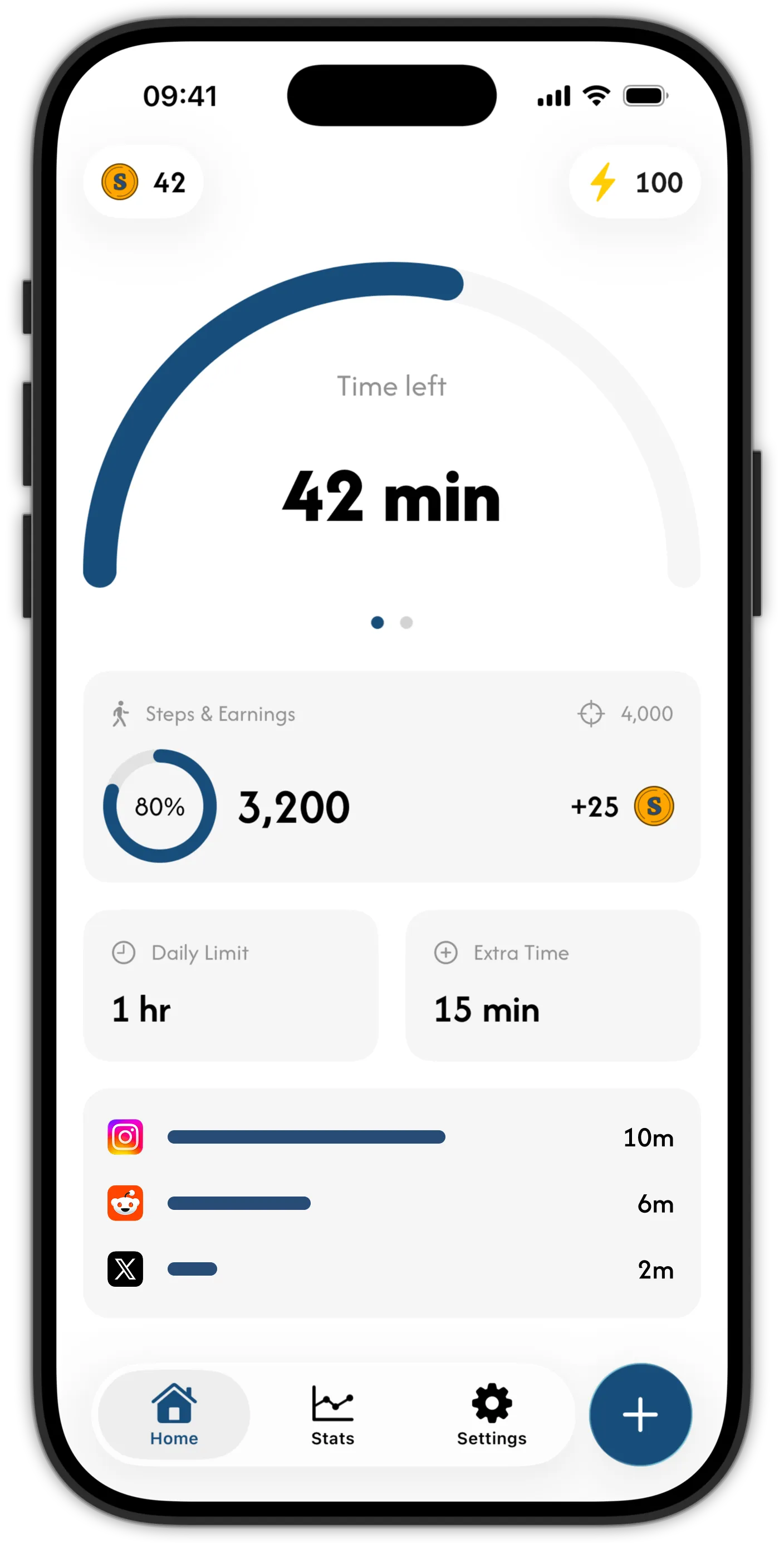
The loop that Skrid is built on (trade walking for screen time) has an angle here that goes beyond willpower and friction. The walking itself supports exactly the brain systems that passive device use tends to undermine. For more on why we built Skrid around this connection, see why walking is central to screen time management.
What to hold onto
Memory is malleable. It always has been. The question is whether we’re shaping it intentionally or letting our environment shape it by default.
The research suggests a few things worth keeping internal: spatial knowledge of places you care about, the core facts in your field, the faces and names of people who matter. Not because devices can’t store this, but because having it internally makes you faster, more present, and more capable of the kind of creative recombination that depends on accessible working knowledge.
Everything else? Let the phone remember it. That’s what it’s for.
The trick is knowing which is which, and actually making the choice rather than letting it happen to you.