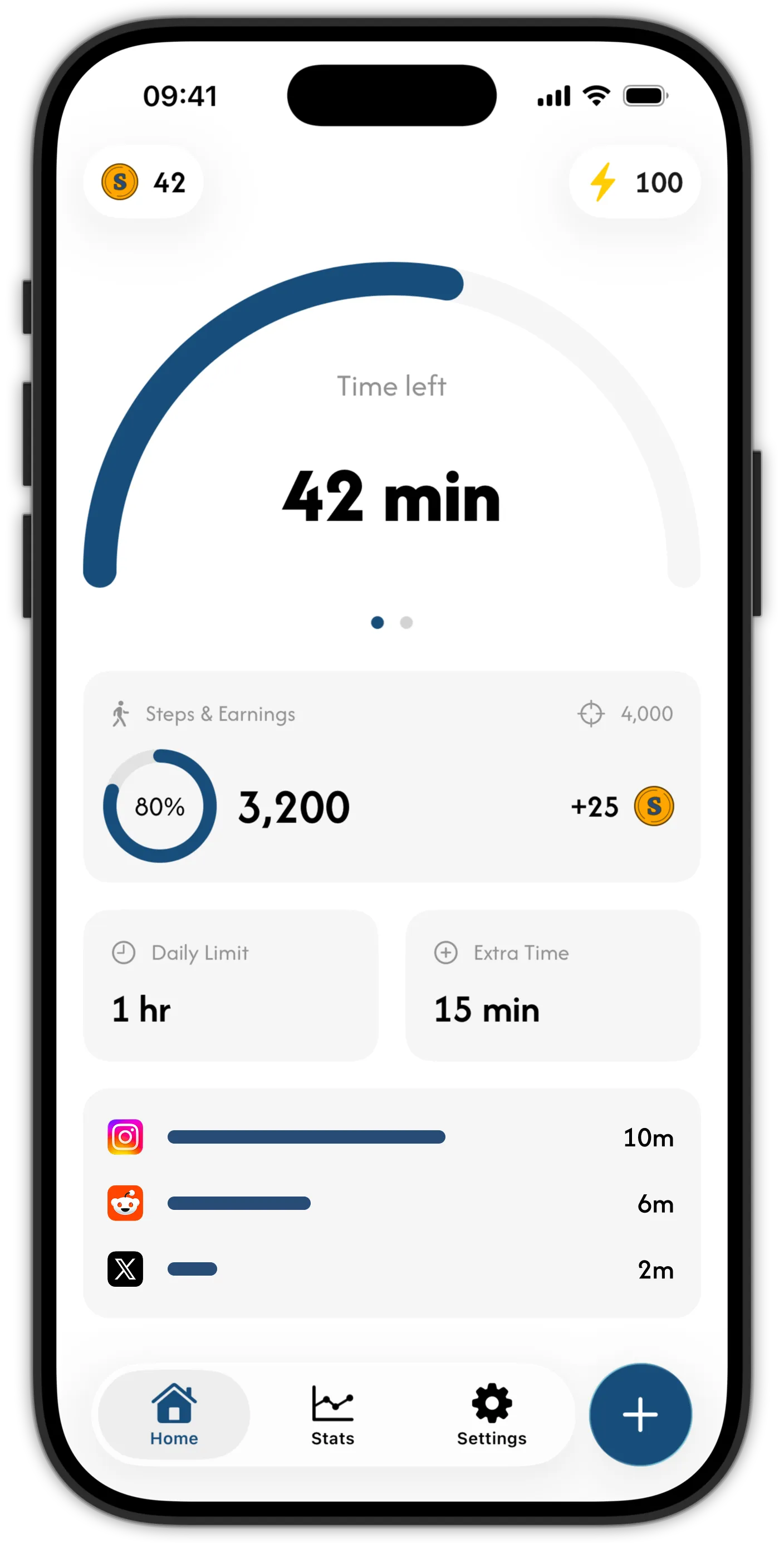
Most people don’t need another lecture about phone discipline. They need a screen time management system that still works on a tired Wednesday night, when motivation is low and the phone is within arm’s reach.
That is the bet behind Skrid: if you want more screen time, you walk for it first.
This comes from a simple observation. Screen habits aren’t only a willpower issue. They are shaped by environment, reward timing, and friction. Phones offer fast rewards at almost no immediate cost, so the default behavior becomes checking, scrolling, and checking again. Even people who genuinely want to cut back often drift into automatic use, especially in familiar moments like late-night bed scrolling or opening one app while waiting in line and losing twenty minutes.
The scale is visible in the data. In its 2024 teens and technology report, Pew Research Center found that nearly half of US teens say they are online almost constantly, and 95% report access to a smartphone at home. In a 2019 meta-analysis in BMC Psychiatry, researchers estimated that about 23% of children and young people show problematic smartphone use, with consistent links to depression, anxiety, stress, and poor sleep.
The sleep link deserves extra attention. A 2022 meta-analysis in Sleep Medicine found that higher smartphone use was associated with notably higher odds of poor self-reported sleep quality. In practical terms, more nightly scrolling often means worse sleep, and worse sleep makes self-control harder the next day.
At the same time, broad panic isn’t useful. A widely cited 2019 paper in Nature Human Behaviour found the association between digital technology use and adolescent wellbeing was negative but small. That feels like the right read: effects are real for many people, but “all screen time is bad” isn’t a serious model. The key question is the loop: what does phone use replace, and what cost does each extra minute carry?
Why screen time management usually fails
Most interventions focus on one move: set a cap and hold it. Sometimes that works in the short term.
A 2025 randomized controlled trial in BMC Medicine reduced smartphone time to 2 hours per day for 3 weeks and found improvements in depressive symptoms, stress, wellbeing, and sleep quality at the intervention endpoint. But usage rebounded quickly, and follow-up values approached baseline once the active restriction ended.
A separate 2025 randomized trial with 787 participants in Computers in Human Behavior tested a planning-based digital detox intervention and found no significant direct effect on total smartphone usage time, even though self-efficacy pathways did move.
The pattern is clear: restriction can create a temporary dip, but if daily incentives stay the same, old behavior returns. A better approach has to change the economics of use, not only the rule.
How walking improves screen time habits and your health
If we’re going to ask people to “pay” for screen time with movement, that movement has to be worth it on its own. Walking passes that test.
In its June 2024 update, WHO reported that 31% of adults worldwide didn’t meet recommended activity levels in 2022, and it reiterated the target of at least 150 minutes of moderate activity per week. Inactivity isn’t a niche problem. For many people, it’s the default.
Step-count data make this more concrete. A 2024 UK Biobank dose-response analysis reported in British Journal of Sports Medicine found lower mortality and cardiovascular risk above about 2,200 daily steps, with stronger benefit as steps rose into the 4,000 to 10,500 range. The practical takeaway is simple: moving from very low movement to moderate daily movement is likely to matter for long-term physical health.
Walking and mental health: the research
The mental-health case is strong enough that it should be treated as core, not optional.
A 2023 umbrella review in British Journal of Sports Medicine synthesized 97 reviews and found medium effects of physical activity interventions on depression and anxiety symptoms compared with usual care.
Step-specific evidence is strengthening too. A 2024 meta-analysis in JAMA Network Open found that adults with 7,000 or more steps per day had lower risk of depression than those below that threshold, plus a dose-response pattern for each additional 1,000 daily steps.
Sleep is part of this loop as well. A 2026 meta-analysis in Sleep Medicine reported that step-increasing interventions improved sleep duration and reduced sleep disturbances versus controls. In day-to-day terms, the same action that earns screen time back can also support better mood, better sleep, and better focus.
That is why Skrid turns movement into the currency for app access.
How earning screen time through walking works
Skrid’s core mechanic is simple: earn phone time by walking, then spend that time inside selected distracting apps.
The point isn’t punishment. The point is intentional use.
Default phone use is immediate and costless in the moment. The spend model introduces a concrete tradeoff. If you want more time later, you walk first. If you burn through your balance during an evening scroll session, access pauses and you decide whether opening that app again is worth earning more time tomorrow.
That turns abstract goals into daily decisions you can actually feel.
Behavior research supports this direction, even if no single study maps one-to-one onto our product. A 2019 systematic review in BMC Public Health found that commitment devices can improve short-term behavior outcomes, while also noting evidence quality limits and the need for stronger long-term trials. In smartphone-specific interventions, a 2021 randomized trial in JMIR and a 2025 randomized trial in Computers in Human Behavior both found self-efficacy changes were relevant, even when total usage effects were mixed.
Our inference is straightforward: a useful screen time system should build repetition, visible progress, and self-efficacy, rather than relying on one hard cap and a short burst of motivation.
Measuring long-term screen time reduction
Skrid will only be successful if it changes the weekly pattern, not just one day of behavior.
We are aiming for a progression:
- People spend less time in low-value, automatic phone use.
- People move more each week, enough to matter for physical and mental health.
- The habit holds through bad weeks, not only high-motivation weeks.
The third point is the real test. Anyone can do a strict digital detox for a weekend. The harder problem is building a loop that still works in normal life, under normal stress, with normal distractions. We care less about day-3 numbers and more about what usage and walking patterns look like after month 3.
That’s why we’re building screen time management around movement. It adds friction where friction helps, and it ties that friction to something your body and mind benefit from either way.
If you don’t want to miss the launch of our screen time management app, be sure to join our waitlist.