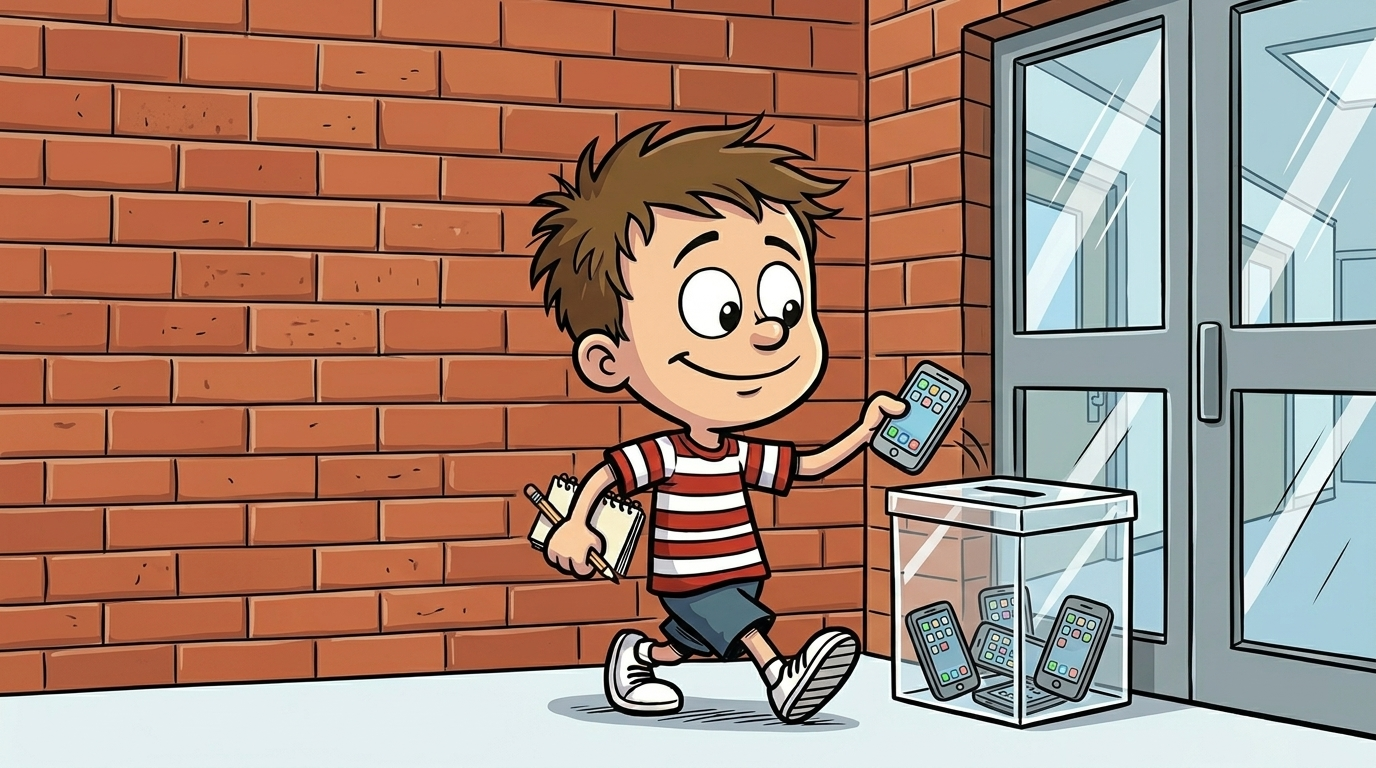
In July 2023, Florida became the first US state to ban phones during instructional time. By December 2025, 35 states plus DC had followed. Twenty-two of those enacted their bans in 2025 alone. New York, the largest state to act, passed a “bell-to-bell” ban in April. Australia’s states progressively banned phones, with most having restrictions by 2024. The UK issued guidance recommending schools develop phone-free policies that same year.
The policy wave moved faster than the research. As David Figlio, an education policy researcher at the University of Rochester, put it: “The policy action is just happening at a level that far surpasses the available evidence.”
Two years in, we can start to see what the evidence actually shows. The picture is messier than either side of the debate suggests.
The academic gains are real
Multiple studies now point to modest but consistent improvements in test scores when phones are restricted during school hours.
A 2025 study from the National Bureau of Economic Research, analyzing Florida’s ban, found a 1.1 percentile point improvement in test scores by the second year. That’s not dramatic, but it held across demographic groups and came alongside reduced unexcused absences.
A large randomized controlled trial involving roughly 17,000 students found a 0.086 standard deviation improvement in grades when phones were restricted. The effects were strongest for lower-performing students, first-year students, and those in non-STEM subjects. An older UK study found larger effects: a 6.4% increase in test scores for 16-year-olds after bans, which researchers estimated was equivalent to an extra hour of instruction per week. Low-achieving students saw the biggest gains.
Teachers confirm the intuition behind these numbers. A 2025 survey by the National Center for Education Statistics found 73% of school leaders say phones hurt attention span. Ninety percent of teachers support bans, according to the National Education Association. One teacher, quoted in reporting on Florida’s policy, described the shift: “Half my energy was spent managing phones or dealing with phone-related behavior.” After the ban, “100 percent” of students took notes and did assignments.
The counterpoint exists. A Swedish study found no change in student performance after restrictions. But the weight of evidence tilts toward modest academic benefit, particularly for students who were already struggling.
The mental health case is weaker than you’d think
This is where the story gets complicated. Policymakers often frame phone bans as mental health interventions. The evidence for that framing is surprisingly thin.
The most rigorous test came from the SMART Schools study, published in The Lancet in 2025. Researchers followed 1,227 adolescents across 30 UK schools with varying phone policies. The finding: no evidence that restrictive policies improved mental wellbeing, anxiety, depression, sleep, or physical activity. Schools with stricter bans didn’t produce happier or healthier students than schools with looser rules.
This doesn’t mean phones don’t affect mental health. It means banning them during school hours may not be enough to move the needle on outcomes that accumulate across a teenager’s entire life.
A Norwegian study found a more specific effect: decreased healthcare visits for psychological symptoms among girls, particularly those from low socioeconomic backgrounds. But this didn’t translate into actual diagnoses. And it took two or more years to show up. Boys showed no effect at all.
The critical finding across studies is that students compensate. They use phones less during school hours, by definition. But their total daily screen time stays roughly the same. One study found students used phones about 30 minutes less in school but matched that reduction with more use outside school. The bans shift when kids use phones, not how much.
This matters because if the mental health concern is really about total exposure to social media, variable-reward loops, and the wanting-without-liking pattern that makes scrolling compulsive, then moving phone use from 1pm to 5pm doesn’t address the underlying mechanism. You’ve rearranged the chairs without changing the room.
Implementation is a mess
On paper, schools have several options: Yondr pouches (magnetically locked pouches that students can only open at the end of the day), locked cabinets, backpack storage, or simple confiscation by teachers.
In practice, these range from expensive to unenforceable.
Los Angeles Unified School District spent millions on Yondr pouches. One school in Folsom, California abandoned Yondr after just one year. Cincinnati Schools spent over $500,000 on the same technology.
Students have proven creative at circumvention. Workarounds include stabbing pouches with sharp objects, sawing through magnetic locks, purchasing unlocking magnets on Amazon for a few dollars, bringing decoy phones while keeping a second device hidden, and using Apple Watches or other wearables that aren’t covered by bans. The technology arms race between school administrators and teenagers is not a fair fight.
Enforcement raises equity concerns. New York City had a phone ban from 2006 to 2015, then lifted it. The reason: evidence that the policy was enforced more strictly at schools serving low-income and minority students. Metal detectors at some schools made phones impossible to hide, while students at wealthier schools faced less scrutiny. When Florida implemented its ban, suspensions spiked 12% in the first year, with Black students and male students disproportionately affected. That disparity faded after year one, but the initial implementation created real harm.
Students and parents are conflicted
Student opinion splits depending on how the question is framed. According to Pew Research, only 17% support bell-to-bell bans, with 73% opposed. But 41% support classroom-only restrictions. The resistance isn’t to all rules. It’s to rules that extend through lunch, between classes, and during the hours that feel more social than academic.
Parents are warmer to the idea, with 74% supporting classroom bans (up from 68% in previous surveys). But many want some way to contact their child during emergencies. In an era of school shootings, that concern isn’t irrational.
The emergency argument cuts both ways, though. During actual crisis situations, phones can help students communicate with parents and emergency services. They can also distract students who should be listening to instructions, cause noise when silence is critical, and spread rumors that interfere with coordinated response. There’s no clean answer.
The honest summary
The honest summary: phone bans in schools produce real but modest academic improvements, unclear mental health benefits, and implementation challenges that range from expensive to discriminatory. Kids compensate by using phones more outside school, meaning total screen time stays roughly constant.
This doesn’t mean bans are useless. A few extra percentile points on test scores, especially for struggling students, isn’t nothing. Classrooms where teachers can teach without managing phone-related disruptions have genuine value. Face-to-face interaction during lunch might matter in ways that don’t show up in mental health surveys.
But the framing of phone bans as a solution to teen mental health problems outpaces the evidence. If the concern is how phones reshape attention, memory, and the brain’s reward systems, the school day is only a fraction of a teenager’s phone exposure. Research on how smartphones affect memory suggests the effects accumulate across all usage, not just the hours between bells.
The harder question is what happens during the other 16 hours. Studies on reducing screen time without deleting apps consistently find that pure restriction fails where friction, environment design, and habit substitution succeed. A policy that says “no phones from 8am to 3pm” followed by unrestricted access from 3pm to midnight doesn’t engage with the mechanisms that make phone use compulsive in the first place.
For parents watching this policy wave and wondering what to do, the school ban is one piece. It’s not the piece that’s going to fix the problem. The hours after school, the bedroom at night, the substitute activities that provide real reward rather than manufactured wanting: that’s where the evidence points. Schools can control what happens on their premises. The home environment is still where most phone use happens, and where most interventions will succeed or fail.
If you’re interested in an approach that ties screen time to physical activity rather than pure restriction, Skrid is built around that idea: earning access to distracting apps by walking. It’s an attempt to replace the loop rather than just block it.